
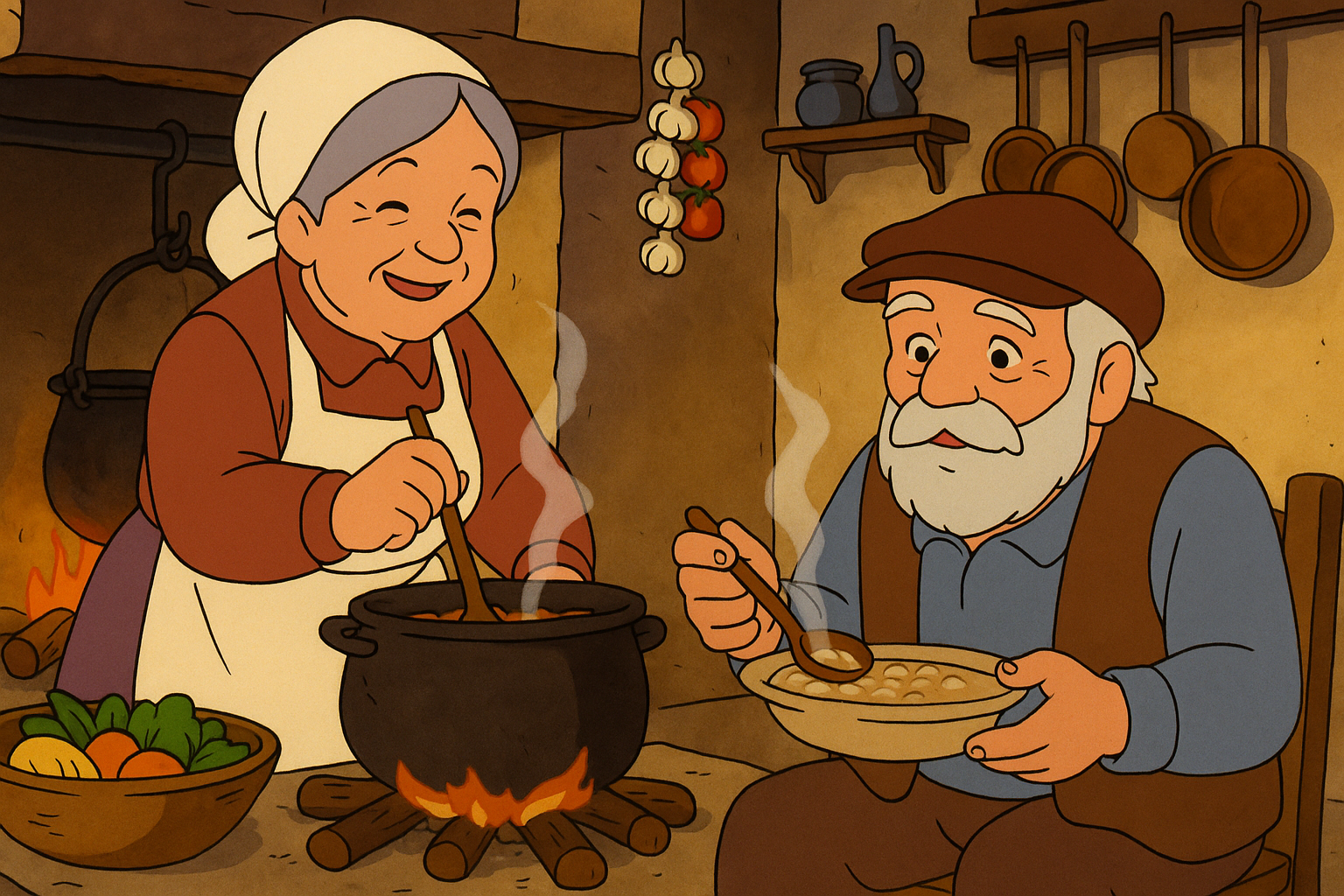
Many years ago, in a small mountain village called Sant Ponç de la Neu, nestled deep in the highlands between Catalonia and Occitania, there lived a woman named Berenguera. She had almost nothing: no money, no schooling, no certificates on the wall. But she possessed a gift no one could replicate – she cooked as if she could speak to the soul of every ingredient.
With a simple chicken and a few herbs from the forest, her dish could have passed for a royal feast. She turned salted cod into something like lobster, and the vegetables she picked could move people to tears of joy. She cooked with intuition, with her hands, with her heart.
She had never been to school. In fact, she could barely read. Everything she knew she had learned as a child, when she went to care for her grandparents, Teresa and Jaume, who lived in a stone cabin perched on the mountainside, surrounded by fir woods and clear, cold streams.
Berenguera climbed up every day with food, firewood, clothes, or whatever they needed. Her grandparents, already old, moved with difficulty, but held ancient wisdom that she soaked up with every visit. Teresa knew all the edible plants of the forest. Jaume raised chickens and caught trout in silence, with traps and patience.
In the dim kitchen, among iron pots, dried garlic and hanging tomatoes, Berenguera watched closely. And without books, scales or rules, she learned. That was her school, and the mountain her teacher.
Years later, when her grandparents were gone, she continued to cook as she always had. The villagers would bring her what they had: a cabbage, a handful of flour, a bit of bacon. And she, smiling, would turn it into meals that filled both the stomach and the spirit.
Her fame grew. One day, word reached Paris and the ears of the great chef Armand Dufort, a cook to kings. Intrigued, he gathered a group of master chefs and set off on the long journey to Sant Ponç de la Neu.
When they arrived, they found a humble woman surrounded by warm smells and slow-burning fire. They requested sophisticated dishes: emulsions, fumets, béchamel creams, and crisp air-ribs. Berenguera didn’t understand those words. But she nodded and began to cook.
The chefs looked on in disbelief. She used no scales, no thermometers, no recipe cards. She followed no apparent method. She cooked by listening – to the flame, to the silence. Yet the aromas that rose from her pots spoke a language they all understood.
They left the kitchen stunned. Chef Armand, pale-faced, declared it all a mess. They went to see the mayor, Ramonet, and offered their help.
They proposed a grand public meal. They would invite everyone and show them how “real” cooking was done. The mayor, delighted, accepted.
On the day of the feast, the village square filled with white tablecloths, steaming pots and baskets of bread. The chefs moved like clockwork. Every ingredient was weighed, every step followed with precision.
Berenguera, by contrast, welcomed each neighbour with a kind word. She accepted a bunch of herbs, a handful of beans, a chunk of aged cheese. She cooked while chatting, laughing, tasting. She followed no manual, yet every dish seemed made precisely for the person who would eat it.
When it was time to eat, the chefs’ plates were admired. They were beautiful, delicate. But people tasted them with respect, not joy.
When Berenguera’s dishes came out, the air shifted. There were silences, bursts of laughter, even a few tears. Her food stirred memories. It warmed hearts. It brought the village together.
Chef Armand tasted. And tasted again. On the third spoonful, he set down his cutlery and began to applaud. With tears in his eyes, he admitted that he knew about process, but not about people. About technique, but not heart.
Days later, Armand left Paris and stayed in Sant Ponç de la Neu – not as a master, but as a student. He wanted to understand what he had never learned in cookery school: the wisdom that lives in a grandmother’s eyes, the intuition of someone who cooks without a clock, and the value of knowing each face you serve a dish to.
“Because what makes a dish unforgettable is not the process, nor the tool – it’s the hand that knows you and the heart that cooks for you.”