
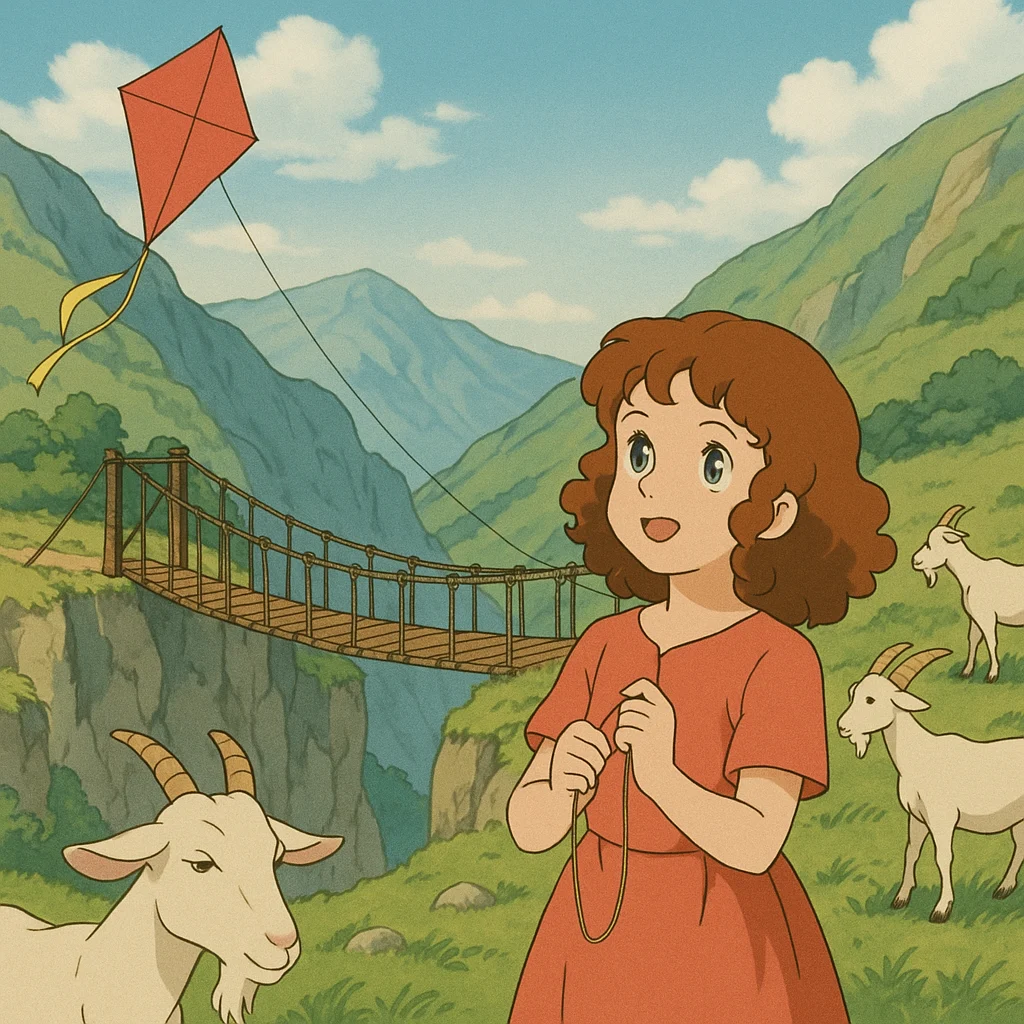
In the mountains of northern Italy, nestled among jagged peaks and green meadows, lay two villages: Vigliasana and Vigliasanta. They were so close they might’ve been twins, separated only by a winding path. The villagers shared everything — the doctor, Tomasso, and the priest, Don Matteo, who traveled back and forth as needed. One day Tomasso might treat a fever in Vigliasanta, the next Don Matteo would bless a new home in Vilasana or offer last rites to someone nearing the end. The rocky path between the villages was short, and life flowed easily between them — like a calm stream.
But one morning, the ground shook with a fury no one could remember. Houses trembled, church bells rang out without being touched, and when the dust settled, a massive chasm — more than a hundred meters wide and so deep no one could see the bottom — had split the path in two. Vigliasana and Vigliasanta, once a short walk apart, now felt like distant worlds. The only way to reach one from the other was an exhausting journey: down the mountain, through a dense forest rumored to hold wolves, across a wild, rushing river, and then up a steep cliff. What had once taken thirty minutes now took over a day — if you were brave enough to attempt it.
In Vigliasanta lived a young goat herder named Livia. She was clever, with wild curls and bright eyes — as lively as her goats. She didn’t just tend to the herd; her mind was always buzzing with ideas. She loved making up games and crafting little inventions. With sticks and colored paper, she had once built a kite that soared so high, it seemed to dance with the stars when the wind was strong.
Livia had friends in Vigliasana, and they used to meet halfway to laugh and swap stories. But now, with the chasm, those days felt like a distant dream.
In Vigliasana, meanwhile, lived Giovanni — a renowned architect who had studied in Florence and could draw bridges as beautiful as they were strong. Desperate, the mayors of both villages asked him to design a bridge to reconnect them. Giovanni took careful measurements of the chasm, made detailed calculations, and declared:“I can build a magnificent bridge, worthy of these mountains. But it will take one year, two months, and three days. And it will cost four million lira.
”The mayors exchanged worried glances. Four million lira was a fortune, and a year was far too long. The sick couldn’t wait, and Don Matteo couldn’t spend a day trekking through the wilderness just to bless a home or comfort a grieving family. But with no other options, they reluctantly agreed. Giovanni began drawing his grand plans.
Meanwhile, Livia had overheard talk of this grand bridge. “A year is too long,” she thought, flying her kite and watching how the wind carried it across the sky. One afternoon, while grazing her goats near the chasm, she saw a falcon gliding effortlessly from one side to the other — the gap didn’t bother it at all. That sparked an idea.
She ran home, gathered more sticks, ropes, and old fabric, and worked through the night with her younger siblings. By morning, she returned to the edge of the village with a much larger kite, rigged with a long, sturdy string. She waited for a strong breeze, then launched the kite toward Vigliasana. Children on the other side, who knew her well, saw it soaring and ran to catch its tail. She shouted:
“Tie the string to a tree!”
They did, and now a thin but strong line stretched across the chasm. Livia tied a small basket to it, slipped in a note for the doctor, and created a makeshift pulley system. She tugged the string, and the basket zipped across the gap. The children sent it back, this time with medicine and a letter from the doctor.
Within hours, Livia had created a way to send small things between the villages. The people of both towns cheered the idea. Soon, they strengthened the line, built larger baskets, and began sending food, tools, and letters. But something more was needed: the doctor and the priest had to cross, and that was far more difficult.
A few days later, Marco, a carpenter from Vigliasana, looked at the ropes and got another idea. He cut wooden planks, tied them together, and — with help from neighbors — fixed them atop the ropes, creating a narrow surface. It wasn’t perfect, but it formed a sort of hanging bridge. It swayed dangerously, and only the bravest dared to cross, gripping the ropes tightly and stepping with care.
Tomasso, the doctor, was the first to try. He shook with fear, but he made it — determined to reach a patient waiting in Vigliasanta. It worked, though everyone agreed it still wasn’t ideal.
Meanwhile, Giovanni kept working on his perfect bridge, with stone arches and pillars that would stand for centuries. But as the days passed, the villagers kept improving their own system. A blacksmith forged a strong metal chain to replace the ropes. Bit by bit, the hanging bridge grew sturdier.
By the time Giovanni finished his elegant blueprints and presented them to the mayors, he was met with a surprise: they didn’t need his grand bridge anymore. The villagers had found quicker, cleverer ways to reconnect — not perfect, but good enough. And, more importantly, they had discovered that by working together and experimenting, they could overcome any obstacle.
Livia, sitting in the meadow with her kite, smiled.
“You don’t always have to plan everything,” she thought. “Sometimes, you just need to begin… and see what happens.”