
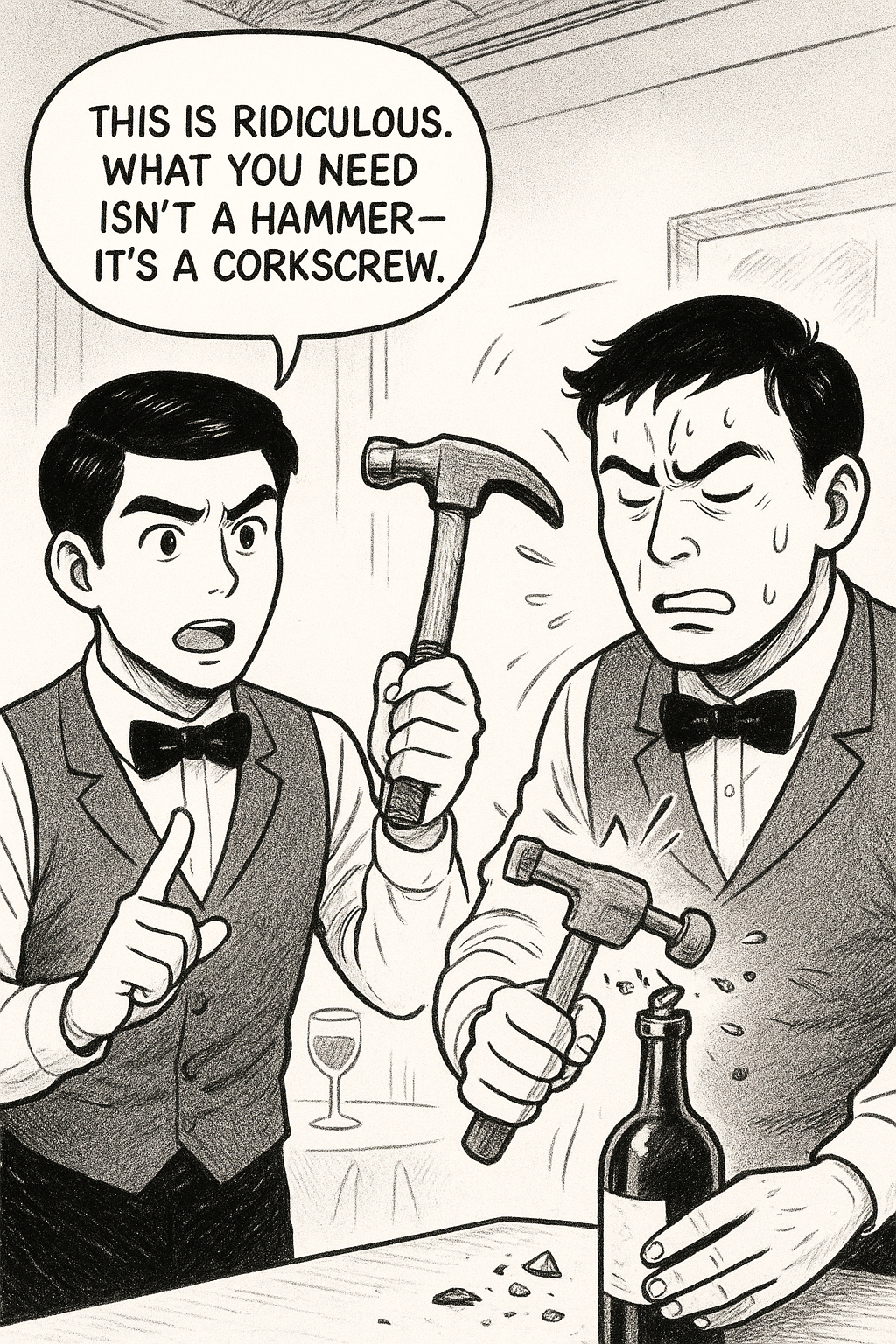
A catering supplies company once managed to convince a restaurant that the best tool for opening wine bottles was — believe it or not — a hammer.
The salesman, clever and persuasive, easily won over his sales director, who proudly promoted the new product as “innovative and efficient.”
The restaurant, trusting their supplier, ordered several of them.
It didn’t take long for the waiters to realise the absurdity of it. Bottles shattered, customers complained, and after some experimentation they found a way to push the cork inside using a pencil and the hammer.
The wine could be served — but with bits of cork floating around and no way to reseal the bottle.
The account manager who dealt directly with the restaurant knew the tool was useless, but saying so would have meant contradicting both his boss and the star salesman. So everyone kept quiet, and the nonsense became routine.
Then one day a new waiter joined the team. Experienced and confident, he took one look at the process and said,
“This is ridiculous. What you need isn’t a hammer — it’s a corkscrew.”
He was right, of course. But truth can be dangerous when it challenges authority. The waiter didn’t want anyone to lose their job, yet he couldn’t keep pretending.
So instead of complaining, he asked for permission to try something different — just as an experiment.
With a modest budget, he bought a simple corkscrew and quietly started using it with regular customers.
They noticed the difference immediately: no bits of cork, no broken bottles, just a clean glass of wine. Word spread, and soon the restaurant manager wanted to know why this waiter was getting so many compliments.
When the truth came out, the restaurant decided to switch suppliers.
The sales company, facing the loss of a major client, was forced to review its products and practices.
The account manager kept his job, now with the task of improving customer relations.
And the waiter? He wasn’t hailed as a hero — he simply proved that the best way to challenge nonsense isn’t with confrontation, but with evidence.