
I. The River Between Two Towns
In ancient times, when maps were more fantasy than science, two towns lived separated by a wide, winding river — the Mirror River — famous for its looping meanders, its black-earth islands, and fish that seemed to leap willingly into fishermen’s hands.
To the west of the river lay Muraclara, a walled and solid town ruled by the wealthy and immovable Baron William of Ironforge. Its tall ramparts symbolised strength, and within them silver coins were minted bearing his stern profile.
To the east rose Altspire, a town perched on a steep hill, shielded by natural walls of rock and thick thorny bushes. The people were humble, yet ingenious. There, ruled the Councillor Irina of the Caves — a leader chosen by the people and descendant of cave-dwellers, renowned for her adaptability and cleverness.
For years, they coexisted without war. Not friends, but not enemies either.
The river provided enough for everyone.
II. The Great Drought and the Chaos
Until the Great Drought came.The Mirror River’s flow shrank into mere trickles. The meanders turned into stranded islands, and the once-clear waters became murky puddles full of trapped fish everyone wanted to catch.
At first, the quarrels were over tangled fishing lines — but soon came tomato thefts at dawn and green potato raids at midnight.
Fishermen spat at each other, gardeners threatened with hoes, and even children shouted insults from opposite banks.
III. The Baron’s Plan
Baron William, fed up with the conflict, summoned his council: knights, scholars, cartographers, and a half-blind elderly astrologer. He demanded a flawless plan to conquer Altspire, seize its fertile land and remaining water sources.
— “I want a plan that cannot fail!” bellowed the Baron. “Every soldier must have precise orders. Every move timed to perfection.
”And so it was born — the Four Calls Plan. Each army section had to sound a horn at each stage:
1. Call of the Dawn: cross the river at first light.
2. Call of the Sunrise: surround the hill from three flanks.
3. Call of the High Sun: blow trumpets to disorient the villagers.
4. Call of Glory: march into town and raise the Baron’s banner.
The soldiers memorised it like a sacred prayer. The motto was: “Thou shalt not improvise!
IV. Altspire’s Art of Survival
Meanwhile, in Altspire, there was no plan. But there was plenty of creativity.
Out of necessity, the people had mastered food preservation: sun-dried mushrooms, root fermentations in clay pots, and salted fish stored in barrels.
The cave-dwelling families knew every hidden tunnel within the hillside. One of them, Luric of the Nooks, was famous for dressing as a tree and frightening goats with a witch’s voice. Another, Nela of the Waters, could identify a fresh footprint in mud purely by smell.
V. The Great Disaster of the Perfect Plan
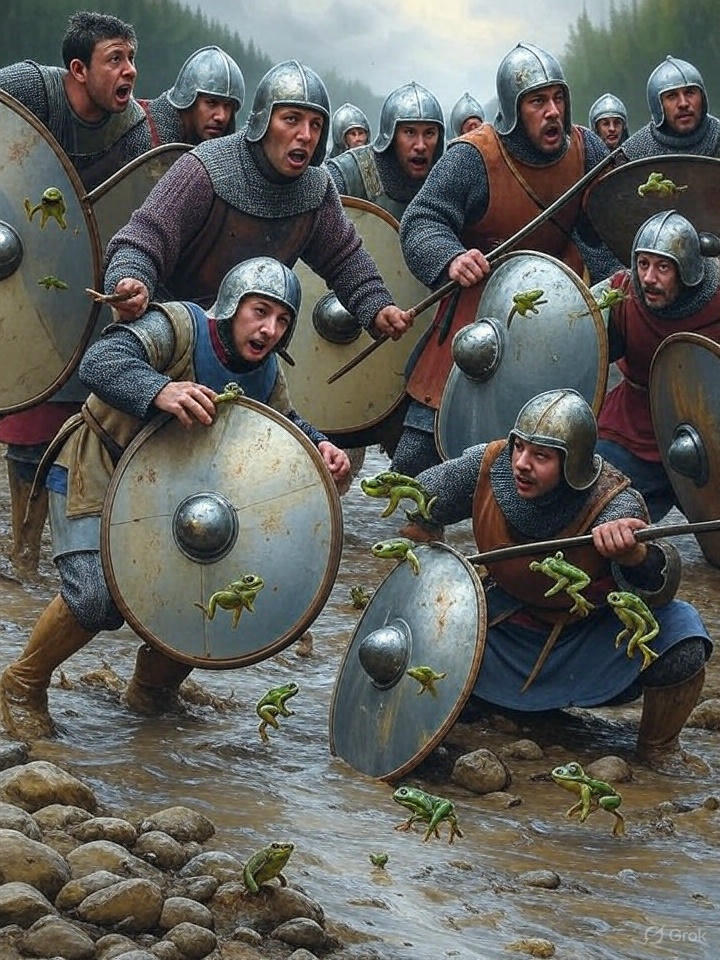
On the night of the attack, Muraclara’s soldiers crossed the river as planned. But… the low water level had left deep, sticky mud. An entire company became trapped up to their knees, and a group of horses got so mired that they were swarmed by excited frogs, mistaking the shining armour for mates.
The second group tried to surround the hill — but the forest was full of false paths laid by Altspire’s children, who had swapped the direction signs once they’d sniffed out the invasion.
One captain marched his troops in a full circle and, upon returning to the start, believed he had conquered the town again.
When the Call of the High Sun sounded, Altspire’s people, armed with kitchen utensils, mimicked trumpets using pots and funnels. The chaos led two Muraclara battalions to attack each other, convinced the enemy was within their ranks.
To top it off, a squad found one of the hidden caves and stormed in with torches, thinking it was a supply store. Inside, a pocket of fermentation gas exploded like thunder, drenching them in sour cabbage and triggering such a frantic retreat that the war chronicler recorded it as “the most fragrant flight in history.”
VI. When Rigidity Crumbles and Adaptability Triumphs
After a morning of missteps, confusion and off-key trumpet calls, Muraclara’s soldiers retreated — defeated by their own plan.
Meanwhile, the villagers of Altspire descended the hill laughing and singing, bringing barrels of pickled vegetables, hard but tasty bread, and jugs of water from hidden springs.
Councillor Irina approached Baron William, who stood with moss in his helmet and mud clinging to his boots, and said:— “We can share the river. But you’ll need to learn how to improvise a little…”The Baron sighed, accepting his defeat with a faint smile.
VII. From Enemy Cities to Sister Towns
In time, Altspire taught Muraclara the secrets of preservation, and Muraclara offered metal tools to better till the land.
Children swam across the river or crossed on floating bridges, and fishermen, instead of bickering over fishing lines, crafted sturdy nets together.
On an island in the middle of the Mirror River, they built a shared square, where every year they held the Festival of the Meander — with theatre, pickled feasts, and a comic reenactment of the Baron’s “perfect plan”. Even the Baron himself played the frog.
And thus, thanks to a plan too rigid and a humble village’s adaptable spirit, Muraclara and Altspire became sister cities.
Better to listen, observe, and adapt… than follow the perfect plan straight into disaster.