
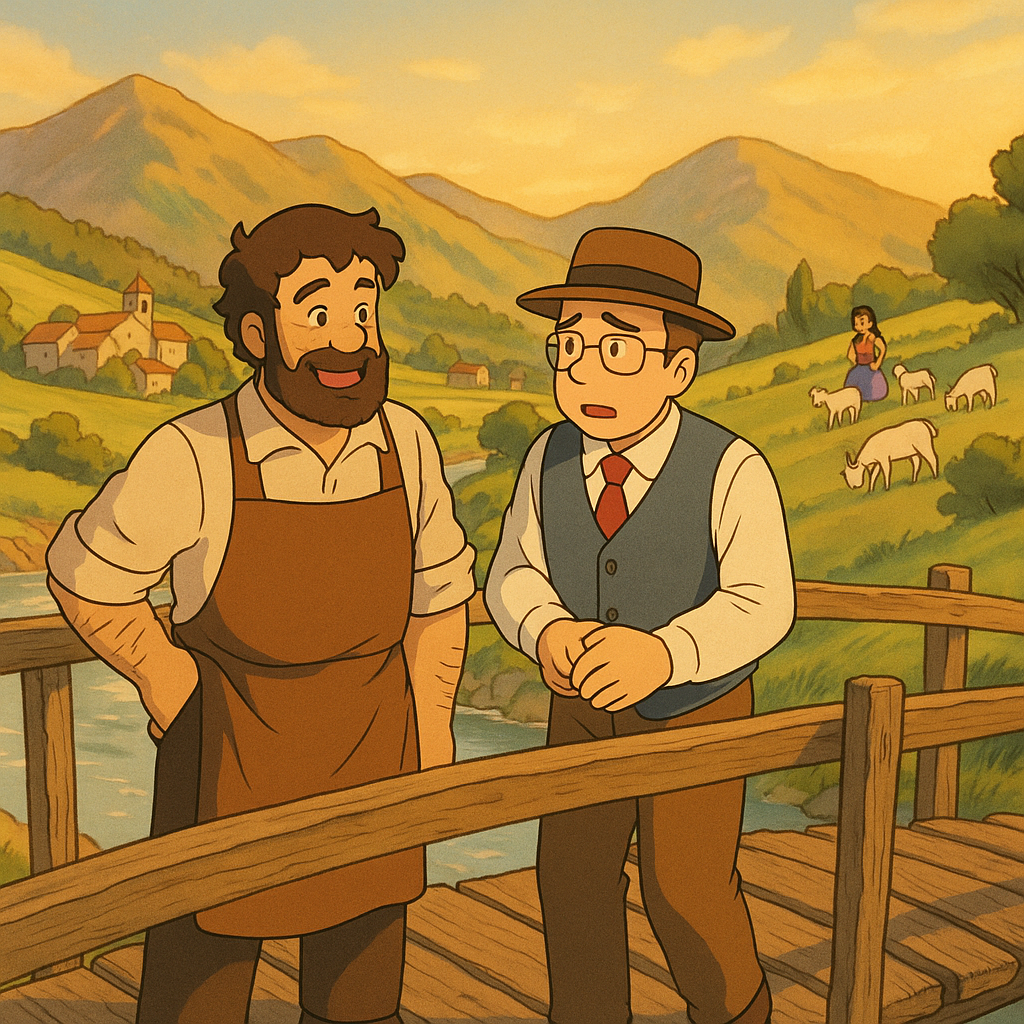
Many years ago, in the foothills of Montcalm, between the villages of Villeneuve and Villardelle, there lived a man who made shoes. His name was Jan Moles, and he was known throughout the region for two things: the precision with which he worked leather… and his stubbornness.
He crafted shoes for farmers, shepherds, dancers from the spring circus, and even the doctor’s daughter, who had feet as delicate as mint leaves. But for every order, Jan always said the same thing:”Trust me. I won’t tell you when it’ll be done, or how many hours it will take. But it’ll be good. And it’ll fit like a glove.”
This way of working didn’t please the merchants. Especially Baldiri, the new shopkeeper from Villardelle, who wanted to resell Jan’s shoes and grow his business.
“Jan, you can’t work like this. I need to know how many days it takes to make a pair. Whether it’s four hours or forty. Whether it’ll cost ten coins or thirty.”
“I don’t know, Baldiri. It depends on the foot, the leather, the day. On whether the rain makes my hand ache, or if Lidia’s goat breaks my grinding bench again,” Jan would say with a half-smile.”This isn’t how you build a business! You can’t make money like this!” shouted Baldiri, rattling the shop window glass.
To try to understand each other, they agreed to do something old and risky: walk together across the Bridge of Unspoken Words — a crooked wooden footbridge crossing the stream between the two villages. Legend says that anyone who crosses it while discussing a disagreement will come to understand the other… if they don’t fall in first.
They stepped onto the bridge. And as they walked, they talked.
“You want me to estimate hours, but you don’t understand what I do.”
“You want to sell me uncertainty, but you don’t tell me how to protect myself.”
“You want fixed prices for living things.”
“You want freedom in a world of contracts.”
And as they kept talking, the bridge wobbled. But it didn’t collapse. In fact, it started to straighten, as if words spoken with honesty were rebuilding it, plank by plank.
By the time they reached the other side, they had reached an agreement. Jan would continue working his usual way with people who trusted him — the shepherds, the dancers, the farmers — but he would also create a new line of simpler, more repeatable shoes that could be estimated in time and cost.
As for Baldiri, he came to understand that not everything can be measured like a sack of potatoes, and that some work is art before it’s a product.
They went home by separate paths. But from that day on, they greeted each other every time they met at the market.
Years later, when Jan’s son — also a shoemaker — wanted to design boots to sell abroad, the first thing he did was go see Baldiri at the shop… and ask him for an estimate of how many days it would take to sell them.
Sometimes estimates aren’t the problem. What’s missing is a bridge that lets us cross the gap between two worlds: the world of doing and the world of selling, of creating and of counting. But bridges — like stories and shoes — only hold if we build them together.